
Glossary of the Hero Realm
Compiled for reference; interpretations may vary.

Sorted by geography, generalized social context, the Arts, and formal glossary of the clans. It is recommended to read Aperture before perusal for the most immersive experience.There’s no major spoilers, but the narrative experience is curated with discovering these things alongside Joran.Map of the hero Realm
For referential use. Material created to depict the regions of the Hero Realm. Some locations are not accurately depicted size-wise, especially the Steppe and Virriben Forest.
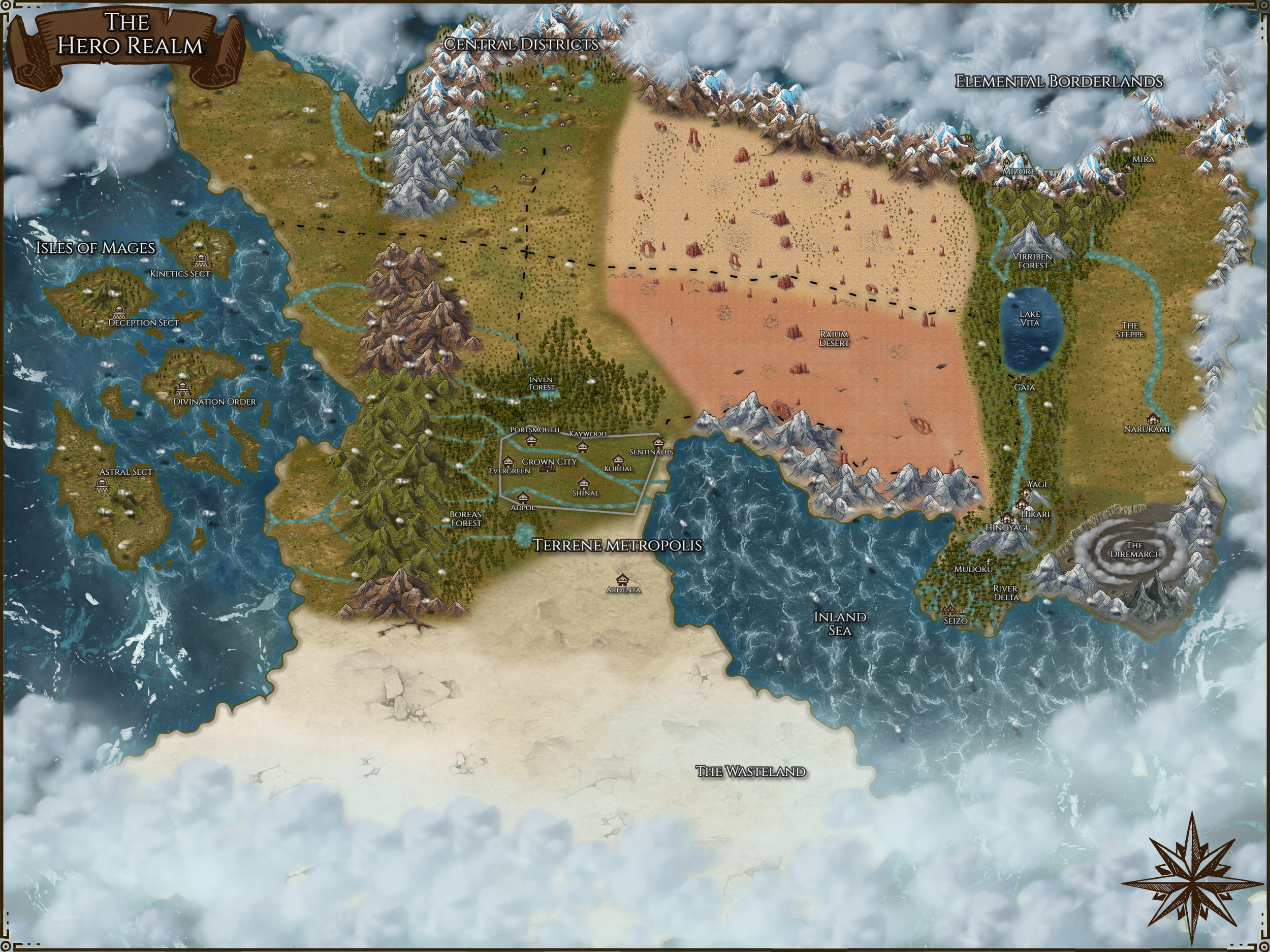
Created using Inkarnate ©Distribution allowed, but credit necessary to both Archiver Butcher and Inkarnate, for the IP and for map creation software rights, respectively.Regions
The western continent of the world. It is where the sole human civilization resides. It is also home to a plethora of wildlife that humans do not regard as “The Beasts.” Humans colloquially refer to their civilization with this term.
The Hero Realm
The region to the north of the Metropolis and west of the Borderlands. It is a cluster of valleys and hills that house educational facilities. It is where all people of the Hero Realm go to learn and study, starting from the ages of 5-8 years old, then leaving when between 18-20 years old.
Central Districts
The population center of the Hero Realm. It sits in a huge, fertile basin that stretches from the western mountains all the way to its eastern shores of the Inland Sea. It was Joran’s home before the Central Districts, and he returned there after becoming the Joker. It is comprised of seven great cities, which can be thought as provinces as well.
Terrene Metropolis
The massive, sprawling eastern peninsula of the Hero realm sitting north of the Inland Sea. It is regarded as mostly wildlands with strikingly unique regions and biomes. Its human population is split into 11 great clans, with one central city called Gaia.
Elemental Borderlands
An archipelago of five islands off the western coast of the Hero Realm. It serves as the residence of the four Orders of Mages. They are extraordinarily isolated from the rest of the Hero realm.
Isles of Mages
Every mountain range in the Hero Realm is connected to one another. There are mountains that border the north, east, and south coasts of the Borderlands. There is a mountain range that cuts the western corridor of the Hero Realm in half, separating the Isles of Mages from the rest of the Hero Realm.
The mountainous Ring
The eastern continent of the world. It is larger than the Hero Realm and heavily shrouded in mystery. Very few humans have been there.
The Beyond
Borderlands’ Sub-Regions
Although primarily a buffer region between the Metropolis and the Borderlands, it is recognized as part of the Borderlands. It is a huge desert, with distinct northern and southern halves, representing different biomes. The northern half is a desert with rocky landmarks in the form of buttes, plateaus, and mesas. It is also the only biome suitable for human inhabitation. The southern half is barren, and desolate, survivable only by the most hardy of wildlife.
Raium Desert
The Borderlands’ huge plains on its eastern side. It is vast, and largely uninhabited except for Narukami and Mira. It is speculated that the Steppe is in fact even larger than Raium. It has a primary, huge river that is also the only known outlet on the Borderlands’ eastern coast. It otherwise has small capillary rivers that eventually connect into the rivers that then funnel into Virriben.
The Steppe
A bulky corridor forest that rests between Raium and the Steppe. It is where the majority of the Borderlands’ clans reside, including where Gaia is. It is rich and varied in flora and fauna, spanning as far north and south as it can reach. It also houses most of the rivers that flow into the River Delta.
Virriben Forest
The Hero Realm’s closest geographical point to the Beyond. As a result, it experiences a multitude of Beasts’ assaults. It is a valley that the Borderlands’ clans agreed to be their vanguard position defending against such assaults.
The Diremarch
A huge sprawling network of interconnected rivers that have created a swampy deposit into the Inland Sea.
The River Delta
Note: It is the southernmost region inhabited by humans, being barely further south than the Ardenta city in the Metropolis.
Factions
The generalized term that the humans refer to themselves as, particularly those who are actively fighting against Beasts.
The Heroes
The term used to refer to the invaders from the Beyond. They are a variety of creatures, monsters, and mythical beasts. Even wildlife that humans would ordinarily not refer to as “Beasts,” if they come from the Beyond and are particularly savage, humans will refer to them as “Beasts.”
The Beasts
The only known faction within the Beasts diaspora that attack the Hero Realm. These creatures are dragons, or draconic in nature. They typically organize attacks that are separate from the normal Beasts’ assaults; but they have been known to launch coordinated attacks in tandem as well. They almost exclusively assault the Borderlands. The only time they have ever been sighted in attacking the Metropolis was during the Onslaught 31 years ago.
The Horde
These are terms that Heroes refer to their organizations and are very interchangeable. As a whole, they can be referred to as “Clans.” There are only very minute differences between the clans, with the way they address themselves representing those small differences. Clans that regard themselves as “Families” are known to be more intimate and tightly knit as an organization. Clans that are called “Sects” are known to be more pragmatic and focused on their Arts. “Guilds” exclusively belongs to Yamatsumi and Seizo, who are mercantile in nature.
Clans/Families/Sects/Guilds
Note: Mizore and Mira both regard themselves as “Clans.”
The blurred line between people’s names, organization names, and actual city names is a result of the Hero Realm’s propensity towards collectivistic identity. Put another way, humans have a deep sense of pride in belonging to their respective organizations. So much so that their surnames play an integral part in their daily interactions and social interconnectivity. People from differing clans often address each other by the clan’s surnames as a form of recognition of authority and especially of perceived prestige.
The only thing that supersedes surnames are given titles, such as Joker, Realm Monarch, etc. Masters can also be referred separately by their given name, as an elevated form of respect.
Surnames
Note: Surnames refer to names such as Mizore, Idaten, Ray, Hinoyagi, etc.
The Arts
Powerful techniques and disciplines that allow Heroes to fight with more than just physical weapons. They are the bedrock foundation of the Hero Realm’s civilization. One’s ability to use the Arts directly impacts the quality of life and social hierarchy in society, in all three human regions. Exceptional and talented users of Arts can be recognized as Masters, savants, and prodigies. Only one Arts can be studied and learned for everyone, except for the legendary Joker.
The Arts of the Metropolis. They enhance and augment individual senses of the user’s body. Or in the case of Myriad Altering Arts, transform the human body.
Users of these Arts typically train with physical routines and exercise, and mindful meditation.
Terrene Arts
The Arts of the Borderlands. They allow a practitioner to wield a particular element that it can manifest or manipulate. Referred to as “essence,” the element can be either drawn from the surrounding environment or conjured from within to be projected into the world. The difference depends on the respective Arts’ ability to manifest or manipulate.
Practitioners of these Arts train with three tenets: Mental Acuity, Physical Stamina, and innate talent, primarily determined through their Soul. Practitioners approach their Arts in an abstract manner as well, bordering on spiritual: specific mindsets improve their ability to use their Arts.
Essence Arts
The Arts of the Mages. They allow an acolyte to perform physical acts by using their minds. They are also the most difficult and extraneous to use.
Acolytes of these Arts exclusively require intense mental training and exercises, often secluding themselves for long periods of time to do so.
Nous Arts
As it is currently understood, the Soul is an internal mental world that every human has. It is an abstract reflection of their psyche, personality, and talent. Typically represented by a landscape that the person most likes, or a place that is important to them. It is speculated that the Divination Order’s Cards predict a person’s future abilities through the Soul. A speculation that the Borderlands wholly agree with and shaped their region around.
Because of the focus that Terrene Arts users have placed on physical training, the Soul has become archaic and redundant, resulting in a significant indifference towards it within the Metropolis.
It is ubiquitously known that no one can be harmed by their Soul’s taken shape or form. For example, even if there’s a continuous hurricane, the individual will not be harmed by being inside of it.
The Soul
Note: No one has ever been known to see another person’s Soul, nor be seen inside of another person’s Soul.
Note: Souls can radically change if a person’s psyche, personality, or well-being is dramatically altered.
Essence Arts
A marker uniquely exclusive to the Essence Arts. A practitioner’s talent and ability to use their Arts can be and often is directly associated with the coloration of their essence when they manifest or manipulate it. The color of essence is widely considered to be that essence’s purity level. When a practitioner ascends to a new purity level, it is unequivocal proof of improvement and mastery.
Essence Purity
Note: Arts that can manifest their essence have four tiers of coloration, while Arts that manipulate their essence have two tiers.
Arts that express in this manner do so by drawing essence into and through the practitioner’s Soul. The practitioner draws the surrounding essence inward, then projects it out, often materializing into physical objects of that essence. Once it has materialized, the practitioner can throw it or use it as a held item. Once it is released, they have no control over it, like a thrown physical weapon, like a sword or dart. The practitioner must continually sustain the manifested item in the same process of drawing essence into them and projecting it outwards. This can be tedious, which is why most practitioners prefer to manifest their items and throw them, in order to reduce the time needed to sustain the object.
Manifestation
Note: Once a practitioner stops sustaining the manifestation, it typically dissipates according to its respective essence. Ice dissolves to mist, Lightning fizzles out, etc.
Arts that express in this manner do so by the practitioner projecting the essence in their Soul outwards to influence the surrounding essence. The most effective illustration of these Arts is to refer to Practitioners as puppeteers of their respective essence. This is considerably less taxing than manifestation. This also has the sharp drawback of requiring their respective essence to already naturally exist. Additionally, these Arts have a larger gap between their essence purities, making it difficult for practitioners to ascend. Which makes their Masters that much more impressive in their capacity.
Manipulation
Once a practitioner has reached the pinnacle tier of their Arts, they gain access to a newfound tier that is vastly stronger and more effective compared to their typical Essence Purity. This increase in strength is proportional to the strain it places on the practitioner’s body. They are strictly taboo to use in any circumstance other than when the practitioner feels they have no other choice but to. This is typically a life-or-death situation, but can also be arbitrated to include extenuating circumstances, such as during the Esso Lum.
With every use of this purity, a practitioner risks their life. For Arts that manifest, their purity can immediately mar their practitioners. For Arts that manipulate, the risk is within the purity feeding back into the practitioner, which can result in permanent disfigurement, loss of Arts affinity, and even loss of life.
Forbidden Purity
Note: Every Essence has a unique color for their forbidden purity.
Lums
Ritualistic combat matches that have taken on different cultural meanings and significances as the Hero Realm’s regions developed into their own, different core identities.
The Metropolis’s form of this ritual. It is a duel where one individual initiates a challenge against another individual. Typically, there is an outcome tied to the result of the duel, which both individuals agree to before initiating. This mutually agreed upon result is almost always extrajudicial in nature and often ignores laws. Due to this, Soma Lums cannot be recognized without at least one third party member that the two challengers agree upon as an arbitrator.
For extraordinary Soma Lums, at least one of the Leaders of the Assembly are required to arbitrate and witness the duel.
Soma Lum
The Borderlands’ form of this ritual. It is a tournament that takes place every three years, where up to three practitioners from each clan participate. They each fight over the span of seven days to secure a position in the Top 12, Top 8, Top 4, and finally the coveted Victor title. Top 12 positions secure a steady income from the agrarian trade the Metropolis supplies to the Borderlands. The proceeding positions grant a larger, greater income from those supplies.
“The Victor” is a prestigious title, all but guaranteeing the title’s owner to be recognized as a Master, although typically all of the Top 12 participants are also eventually recognized as Masters. Being a Victor can provide a great amount of influence, particularly within the Victor’s own organization, who benefit from getting the lion’s share of the Metropolis’s supplies for the next three years.
Esso lum
Note: Esso Lum participants must be 25 years or younger. They can also only attend two Esso Lums in their lifetime.
The Isles of Mages’ form of this ritual. It is a duel, similar to the Soma Lum. However, as an arbitration tool or serious event, it has become an archaic tradition in modern times. Younger mages often engage in Nous Lums mainly for entertainment purposes. The function of a Nous Lum continues as a form of training, however.
A Nous Lum is a melding of the minds. Its original purpose was to see which mage could overpower the others through sheer mental fortitude. This can often be described as a battle in an abstract mental space, where the two mages have to conjure abstract attacks, using whatever their minds can create. This function has proven to become very useful for training purposes, so Mages have implemented it as such.
Nous Lum
Note: Although the mental space might appear to be the Soul, these mental fields are fundamentally different; instead being a space conjured by one or both Mages.
The Hero Realm’s Clans
Altering Cael Sect. Cael surname. Myriad Altering Arts, allows the user to transform their body to mimic Beasts.
Terrene Metropolis
Distilled Mind Family. Argo surname. Distilled Mind Arts, augments the user’s mind, allowing them to have near instantaneous processing abilities.
Divine Eye Sect. Jura surname. Sacred Sight Arts, augments user’s sight, allowing some to see through obscurity; some can even see through thin walls.
Earthbound Clout Family. Gouriki surname. Heavenly Clout Arts, allows users to become incredibly strong.
Sub-divided with two stratums, Rooted Clout Family (medial status), and Nascent Clout Family (lower status).
Metal Boulder Sect. Suekamikou surname. Steel Body Arts, augments user’s body to become incredibly durable, tougher than steel.
Sovereign Swift Clan. Idaten surname. Sovereign Realm Arts, allows users to become incredibly fast.
Sub-divided with a lower stratum, Agile Swift Clan.
Warding Bloodhound Clan. Heca surname. Blood Gazing Arts, augments users’ sense of smell, enhancing capabilities after smelling Beast blood.
Burning Skies Clan. Hinoyagi surname. Smiting Flames Arts, manifests Flame Essence.
elemental Borderlands
Darkened Lands Clan. Yagi surname. Yin Arts, manipulates Shadow Essence.
Druidic Woodland Sect. Ray surname. Druidcraft, manipulates Floral Essence.
Earthen Guild. Yamatsumi surname. Tremoring Ground Arts, manipulates Rock Essence.
Frozen Storm Asgard. Mizore surname. Ice Tempest Arts, manifests Ice Essence.
Glazed Glass Palace. Mira surname. Shimmering Mirage Arts, manipulates Glass Essence.
Luminous Heavens Clan. Hikari surname. Yang Arts, manipulates Light Essence.
Miasma Family. Mudoku surname. Mudoku’s Art, manifests Poison Essence.
Okeanos Guild. Seizo surname. Surging Tide Arts, manipulates Ocean Essence.
Rumbling Heavens Family. Narukami surname. Rumbling Heavens Arts, manifests Lightning Essence.
Serene Aery Sect. Shinatsu surname. Turbulent Winds Arts, manipulates Air Essence.
Astral Sect. Seiki surname. Capable of short-distance teleportation, creates and maintains portals for long-distance teleportation.
Isles of Mages
Deception Sect. Koukatsu surname. Capable of invisibility, they do this by erasing others’ perception of them.
Divination Order. Uranaishi surname. Predictors of innate human potential, they created the Card Exam and System.
Kinetics Sect. Douteki surname. Capable of Telekinesis, they can move physical objects with mental will, no physical interactions.